Your company is headquartered in San Francisco, incorporated in Delaware, and down to eight weeks of cash. A buyer wants the code and plans to hire the engineers, but it will not take on the leases or vendor claims. The board needs a way to sell what has value, pay creditors what it can, and wind down the business cleanly and quietly.
In California, the usual answer has been an assignment for the benefit of creditors (an “ABC”). The board transfers the company’s assets to an independent fiduciary, called an “assignee,” which sells the assets and distributes the proceeds to creditors. Since June, the board has a second question to answer, and few boards know to ask it: which state’s ABC?
The question exists because Delaware adopted a new uniform ABC statute this summer. California is reviewing whether to follow. A subcommittee of the California Lawyers Association’s Insolvency Law Committee (the “Subcommittee”) aims to present its final position to the state’s uniform-law commission on October 27. Founders, boards, and venture capital partners have more riding on that review than its low profile suggests.
Why venture-backed companies use ABCs
An ABC is a state-law alternative to bankruptcy. The company, not its creditors, starts it. Compared with a bankruptcy, an ABC is usually faster, cheaper, and more private. The Subcommittee itself describes ABCs as a widely used, well-established way to wind down insolvent California businesses.
The mechanics are simple. The board selects the assignee and approves the assignment, subject to any required stockholder or contractual consents. The company then transfers its assets to the assignee. The assignee then markets and sells the assets, sometimes to a buyer lined up before the assignment. The assignee notifies creditors, reviews their claims, and pays them in order of priority. An ABC does not dissolve the company, though, so the board still has work to do afterward, including formally dissolving it.
The trade-offs are real, however. An ABC has no automatic stay to halt creditor lawsuits. Creditors keep the right to file an involuntary bankruptcy petition, which can override the ABC. An ABC sale also lacks the free-and-clear order provided by a court-approved sale under Section 363 of the Bankruptcy Code. Delaware’s new statute narrows that gap: it discharges certain subordinate liens on a sale and lets an assignee ask the Chancery Court to approve one. For many venture-backed companies, whose value sits in people and IP that leave quickly, speed still wins.
What changed this year
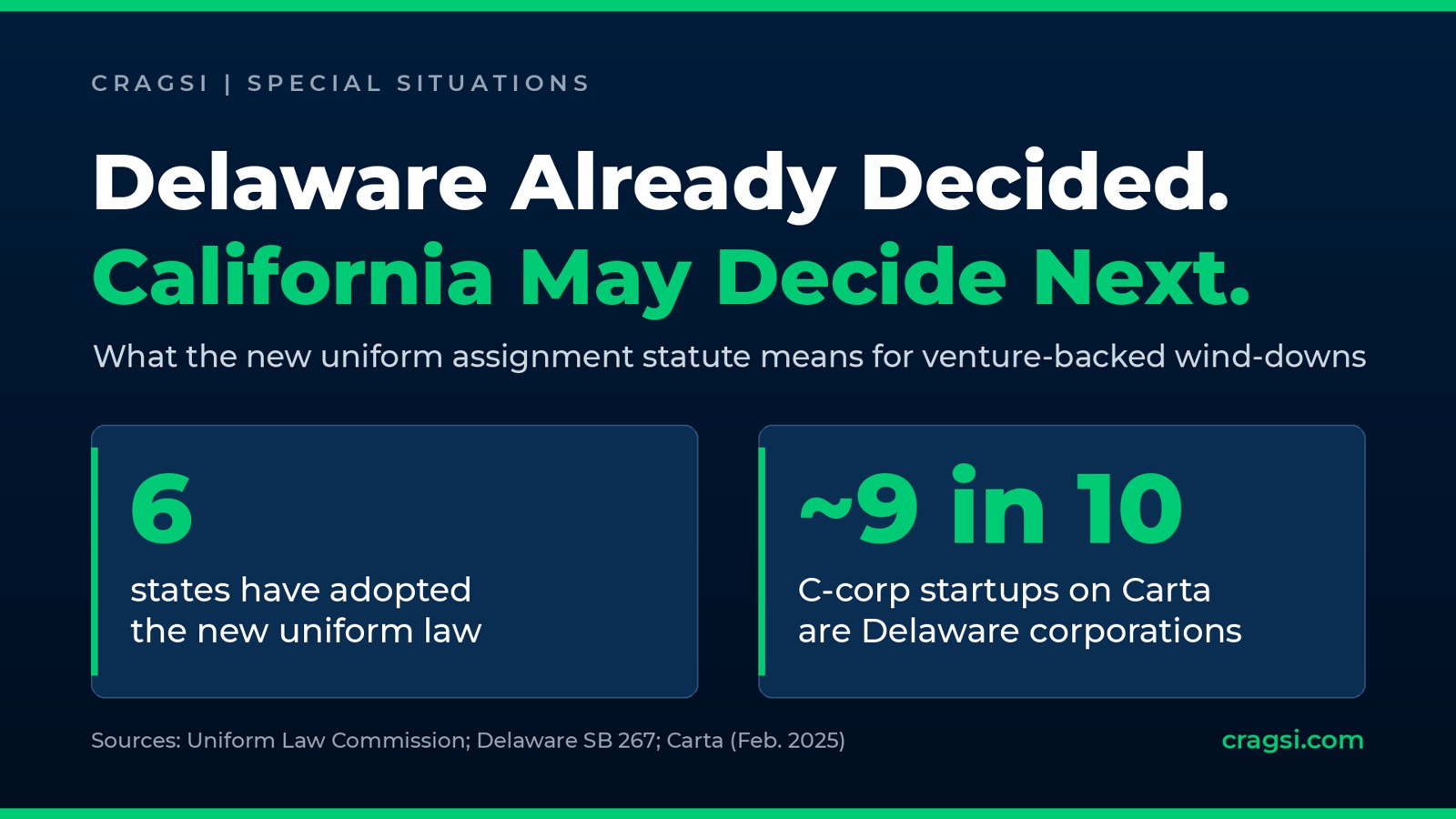
ABC law has long varied widely from state to state. In July 2025, the Uniform Law Commission (the “ULC”), co-author of the Uniform Commercial Code, approved the Uniform Assignment for Benefit of Creditors Act (the “Uniform ABC Act”). The final text and commentary followed in October. Six states have enacted it so far in 2026: Alabama, Arizona, Iowa, Nebraska, Utah, and, on June 10, Delaware.
Delaware is the one that matters most for venture-backed companies. While the Uniform ABC Act covers companies headquartered in an enacting state, it also covers companies incorporated there. Carta data published in February 2025 show that about 9 in 10 C-corporation startups on Carta are incorporated in Delaware, mostly because investors prefer it. Most venture-backed California companies can therefore consider a statutory Delaware ABC, even if all of the company’s employees, creditors, and assets are in California.
Eligibility is not the whole answer, though. Existing liens, contracts that cannot be assigned without consent, and the rights of creditors in other states still shape what a Delaware assignee can do.
Delaware also adjusted the uniform text a bit. Delaware’s version requires the assignee to petition Delaware’s Chancery Court within 14 days. The filing creates a public record. Delaware also dropped the bond and two appraisals that its 1875 statute required, both at the estate’s expense.
For a board considering an ABC in Delaware, the court filing cuts both ways.
Privacy is often a main reason boards choose an ABC over bankruptcy, and a Chancery filing makes the wind-down easier to find. The filing also gives the assignee access to the Chancery Court for instructions, approval of sale procedures, and resolution of disputes. California ABCs, by contrast, have traditionally operated largely outside of court.

The choice boards now face
For a Delaware company based in California, the choice now runs between California’s established practice and Delaware’s statute. Neither suits every company. The answer will often turn on facts, including where the assets sit, who the creditors are, and how much privacy the board wants.
The differences that matter to directors are practical, not technical. The Uniform ABC Act makes the assignee a fiduciary who owes a duty of loyalty and a duty to use reasonable care to maximize what creditors receive. It bars creditors, insiders, affiliates, and anyone else with a material financial stake in the outcome from serving. The assignment agreement must state the assignee’s fees and how they are calculated.
The assignee must also send creditors periodic summaries and a final accounting, including fees, at the end. The uniform text sets a six-month cadence for those summaries, while Delaware leaves the timing to its Chancery Court. Careful assignees already do much of this. The Uniform ABC Act makes it a requirement rather than a practice.
Directors also care about their own exposure, and here the statute’s protection is narrow. The company is not liable for the assignee’s conduct. The person the company designates to work with the assignee keeps whatever protection that person would otherwise have, absent gross negligence or willful misconduct. The statute does not shield directors from claims about earlier decisions, and it does not change their fiduciary duties.
One question remains open. The Uniform ABC Act’s rule on recognizing other states’ ABCs binds only states that enact it. Unless and until California does so, a Delaware ABC may still have to account for California law on California assets and creditors. The Subcommittee has itself flagged the Uniform ABC Act’s reach over out-of-state assets as a significant concern. A board weighing a Delaware ABC should ask its advisors how that plays out on its facts, and why they recommend one state over the other.
October 27 and California’s harder question
The California Commission on Uniform State Laws meets in Sacramento on October 27. The Subcommittee’s stated task is to decide whether California should adopt the Uniform ABC Act in full, in part, with modifications, or not at all.
Neither step would change California law. Adoption would still require legislation. The meeting agenda lists the Uniform ABC Act for discussion, separately from the uniform acts under consideration for introduction in the 2027 legislative session.
The ULC’s official commentary says the Uniform ABC Act displaces common-law assignment procedures in a state that adopts it. California built its ABC framework from statute and common law over decades, so wholesale adoption would replace a working system.
Supporters see codification as a way to replace local custom with written rules that every participant can read. But codification can also disrupt procedures that already work. That makes adoption a harder question in mature-practice states like California than in states with little developed ABC law. Delaware took a middle path, adopting the Uniform ABC Act with changes suited to its own courts. California may do something similar: one Subcommittee member has said publicly that the group will likely recommend incorporating targeted provisions into California’s existing framework while preserving its nonjudicial character.
California’s decision also matters to Delaware corporations operating in California, particularly for the treatment of their California assets and creditors. And roughly 1 in 10 C-corporation startups on Carta is incorporated outside Delaware, most often in the state where it operates.
Four questions every board and venture partner should ask
Boards often ask first what an assignee will charge and treat the service as a commodity. Fees are not where the analysis should begin. Before committing to an ABC, directors and their advisors should answer four questions.
(1) Is liquidation the right answer? Most of the boards our firm sees reach the wind-down decision too quickly. Before choosing an ABC, the board should evaluate alternatives, including a restructuring, a recapitalization, or a going-concern sale outside an ABC. In one case, a venture-backed life sciences company’s board had scheduled a Monday vote on an ABC. Over the preceding weekend, we identified a bridge lender, and financing was structured and closed before the vote. The vote never took place, and the company continues operating today.
(2) Which state’s process, and why? Treat the choice of regime as part of wind-down planning, and ask advisors to explain their recommendation on the company’s facts.
(3) How will the assignee report and charge? Ask every candidate, under any regime, for its fee basis in writing and its reporting schedule. The Uniform ABC Act’s reporting rules make a useful benchmark even where it does not apply.
(4) Is the outcome still open? An assignee’s duty runs to creditors. Founders sometimes hear, during an assignee’s pitch, that an ABC can route the assets to the founder’s next company or to a related bidder. Related-party and pre-arranged buyers can be legitimate, but only through an independent, disclosed process open to better offers. No assignee should guarantee a favored buyer an outcome at the expense of an independent process or better offers.
Whatever the answers, bring the eventual assignee in early. The Uniform ABC Act expressly allows an assignee to have worked for the company before the assignment without being disqualified. Early preparation preserves value that otherwise disappears between the board’s decision and the assignee’s first day.
For venture capital partners, these questions repeat across a portfolio. Portfolio companies look to their investors for referrals when cash runs short. A partner who recommends an assignee should be able to explain why that assignee, and why that state. Asking early costs nothing. Asking in the last two weeks of runway often means taking whatever process the first advisor proposes.
Delaware has already changed the ABC calculus for many venture-backed companies, and California may follow. For a board facing a wind-down today, the question is no longer only whether an ABC is appropriate. It is also which state’s process best serves the company and its creditors, and why.
Originally published on LinkedIn on October 26, 2026.